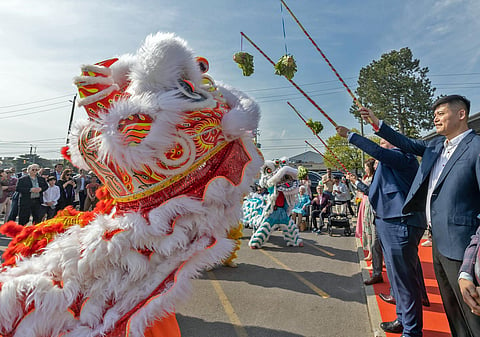


On a sunny Sunday afternoon, the 2026 AHM Canada-China Culinary Cultural Exchange was held in conjunction with the grand opening of Luna Private Banquets, a new and extravagant complex of 28 private banquet rooms in Markham. It brought together a curated panel-discussion exploring the intersection of Eastern and Western culinary traditions, insightful conversation on business etiquette, and fostering a deeper understanding between cultures and live culinary demonstrations, highlighting the artistry and philosophy behind Chinese and Western cuisine.
The Panelists from different walks of life, each brought to the discussion, our own views about food and dining:
Leo Chan, Cambridge Food and Wine Society, Professor Chef at George Brown and Humber College
Sara Waxman, OOnt, DINE Magazine, Owner and Editor-in-Chief
Jackie Lin, Shoushin, Owner and Head Chef
James A. Thompson, Writer and History Instructor
Moderator Justin Poy, President of the Justin Poy Agency, is the Honorary Patron of Asian Heritage Month (Canadian Foundation for Asian Culture) and one of the founders of multicultural advertising and marketing in Canada. The discussion centered around personal vignettes and opinions, but the proof, as they say in the West, is in the pudding.
A meal can become a form of social architecture where alignment becomes emotionally real rather than merely contractual.
A shared meal has always been more than nourishment. Across civilizations, dining has served as a mechanism for diplomacy, trust building, negotiation and cultural exchange. In both business and political settings, hospitality can alter the emotional temperature of a conversation and shape the outcome of relationships.
A meal changes the context of negotiation. People stop interacting only as titles, positions or opposing interests, and begin interacting as human beings. The pace slows. Defenses soften. Humor, generosity, listening habits, and emotional intelligence become visible.
Historically, diplomacy, political alliances, commercial partnerships and major cultural moments have unfolded around tables rather than inside formal boardrooms. In many industries and cultures, the real negotiation often begins once everyone sits down to eat.
Western and Chinese traditions of hospitality often pursue different objectives. In many Western business environments, hospitality supports the transaction. In many Chinese contexts, hospitality is part of the negotiation itself. Chinese business culture often emphasizes relationship building before trust is granted. The dinner becomes a way to evaluate character, social awareness, and long-term compatibility.
Western business culture, particularly in North America, often prioritizes efficiency, agenda setting, and transactional clarity. The difference can create misunderstandings. Western guests may see elaborate hosting as excessive or indirect. Chinese hosts may interpret efficiency-first behavior as emotionally cold or premature.
Private dining rooms in Chinese culture frequently symbolize respect, status, confidentiality, seriousness, and relationship importance. The room itself communicates meaning. For Western guests unfamiliar with this cultural language, the environment may appear overly formal and theatrical. For the Host, however, the setting often reflects care, dignity and strategic intention.
In traditional Chinese banquet culture, seating carries symbolic importance. The seat facing the entrance is often reserved for the principal guest. The host typically occupies a strategically balancing position. Seniority and alliance may determine placement. A Western guest who casually changed his seat or dismisses seating protocols may unintentionally disrupt an entire social structure.
In Chinese hosting traditions, the menu itself communicates values. Abundance signals generosity and respect. Specific foods may symbolize prosperity, longevity, unity, harmony. Fusion cuisine emerged as a major force during the 1990s and early 2000s. Chefs combined French technique with Asian ingredients. What was once experimental eventually became normalized.
Western and Asian cuisines often pursue different forms of excellence. Classical Western cuisine frequently celebrates transformation through techniques. Sauce-reduction, precision cooking, pastry architecture, layered complexity. Many Asian cuisines pursue equilibrium among sweetness, acidity, heat, aroma, texture, umami, temperature. Chinese cuisine in particular places exceptional emphasis on texture and mouthfeel.
Toasting rituals in Chinese business culture often carry strategic meaning. Who initiates the toast, in what order, with what language, and toward whom can all communicate Respect, Humility, Alliance, Hierarchy and Future intention.
Frank Scarpitti, Mayor of Markham
Mario Racco, Local and Regional Councillor in the City of Vaughan
Isa Lee, Ward 8 Councillor
Logan Kanapathi, MPP - Markham Thornhill
Henry Lee, Consulate General of Malaysia
Linda Lam, MP for Markham-Unionville
Alan Ho, Regional Councillor, Markham
Joe Li, Regional Councillor, Markham
A multi course luncheon graciously hosted by Tim Lin, owner of Luna, in one of the splendid private dining rooms, proves the points we had made. An air of celebration fills the room. White tablecloths sparkled on round tables; glass turntables at the ready; two sets of chopsticks at each place setting—one for serving ourselves and one to use for eating. Let the service begin. Wine is poured. Platters of cold appetizers and a Chef’s selection of delicacies, including traditional hand-made dim sum, turn slowly around the table in traditional serving style.
A Garden Salad is the palate refresher before the sumptuous main courses of Lobster in Golden Broth and aromatic Red Wine Beef. And the last dish is, of course, Fried Rice with Seasonal Vegetables and Mixed Grains. Classic, Traditional, a feast for the eyes as well as the palate.
The interior of Luna is one of hushed privacy. The dining rooms may be filled to capacity, but not so much as the sound of a cough escapes into the hallways. Each dining room has a unique tone as well as its own set of utensils, its own patterned-dishes and serving pieces created specifically for Chinese cuisine. A living room area with furnishings of sleek elegance and a round table crafted of rich dark wood is centered with an electric turntable that can accommodate all the banquet dishes. No need to ever ask, “Please pass the steamed shrimp dumplings.” The lighting enhances the subtle colour scheme, and even the ceiling makes a design statement.
Owner Tim Lin has left no stone unturned to offer an exceptional experience to a Host and guests. Wherever the eye falls, there is calm and comfort.
I pay attention to the style of service which is not the usual restaurant format. Servers are totally unobtrusive and use a service area for last second touches. Then, the dish is discreetly presented to the Host before it is set on the table. Respect.
Luna Chinese Private Banquets brings a level of private dining to our community that is the epitome of luxury and elegance. And there are other intriguing opportunities. Two levels of Private Membership will afford members extraordinary luxuries, privacy and discretion. An opulent bonus includes a AU999.93 grams Gold Membership Card upon activation.
While there is much more to this event than my distillation, and even more surprises during my Private Dining Room lunch, we all agree that East is East and West is West—but over the dinner table, the twain does meet.