

In June of 1969, Hamlet opened the Stratford Festival. We were newlyweds driving to see the play in a rented car. My husband, Al Waxman, was a young actor whose dream it was to act on the stage at the Stratford Festival. I had never seen a Shakespeare performance and I had never read Hamlet. Little did I know at the time, how this small theatre community would become inextricably intertwined in my life.
My late husband did fulfill his dream. In 1997 he won acclaim for his portrayal of Willy Loman in the Festival’s production of Death of a Salesman and was signed to play Shylock in Stratford's 2001 production of The Merchant of Venice until his untimely death in 2001.
Years later our son, Adam Waxman, performed at the Stratford Festival in Henry IV, Part II and Duchess of Malfi. And there is more. Tonight, I am in the audience at the Festival Theatre, waiting with anticipation, to see my 12-year-old grandson, Asher Albert Waxman, play “The Boy” in Waiting for Godot. Three Waxman generations at the Stratford Festival in my lifetime.
Waiting in the lobby for curtain time, the mood is palpable – there are questions. What does this play mean? There are no answers in the Program. Only more questions.
I read the play several times, and it’s meaning eludes me – in fact all of its meanings elude me. Who is Godot? I ask for opinions.
Asher says, “In my generation, GenAlpha, we’re waiting to be told what to do, and we’re on line with Minecraft or Roblox and we’re waiting for updates. We see adults talking about the world and politics, and they’re all waiting for something to happen. In Waiting for Godot, there are two adults waiting together, and they can’t figure out the algorithms, but the updates aren’t coming, like the server crashed.”
Molly Atkinson, the Director of the play writes: “Maybe we are waiting for something to make things better, or to tell us what we are meant to be doing here. Or perhaps something to tell us what it is all for and who we are. And that it matters.”
Antoni Cimolino, Artistic Director of the Stratford Festival writes: “It questions both our place in the universe and our expectations of drama itself.”
Samuel Becket, the author of the play says, “If I knew, I would have said so in the play.”
Still, there is one question unasked and unanswered. Why do we assume Godot is a man? Godot might be a woman, or gender non-conforming, or a child, or a Supreme Being.
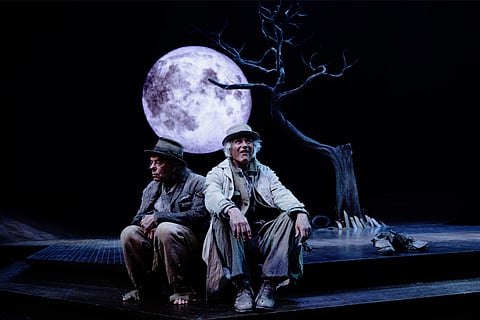
The curtain opens on a stage with a single barren tree. Two wandering men, old friends Vladimir (Paul Gross) and Estragon (Tom McCamus) meet again, embrace and begin to wait for a mysterious person named Godot. During their waiting, they talk, argue, joke, remember fragments of the past—and like a sudden hurricane or volcanic eruption, two strange characters enter the scene: Pozzo (Jonathon Goad) the wealthy master and his slave, Lucky (David W. Keeley). There is violence. The audience reacts as one, and gasps at this crude display of man’s inhumanity to man. They depart. Godot has not yet arrived. But the tree sprouts a leaf. Is this a ray of hope; a portent of good? And yet, it goes unrecognized. Why? Is this a hint that humanity ignores a sign of positive change? Or is it just a leaf to indicate the change of seasons as a timeline of the play.
Waiting for Godot is one of the most famous and influential plays of the 20th century. Central to the plot is “waiting.” Vladimir and Estragon spend the entire play waiting for Godot. Each member of the audience is also waiting: What does Godot represent? By now we are losing hope that he will show up. He sends an emissary with a message: a boy (Asher Albert Waxman) who arrives like a breath of fresh air, a moment of innocence in the discord and poverty on the stage. And he reports, “Godot will not be coming today – but surely tomorrow.” (The alternating young actor who plays “The Boy” is Gordon Paul Miller.) At this point, we figure the meaning of the play is salvation, purpose, authority, God, or simply the hope that life will improve.
The characters often forget what happened yesterday, creating uncertainty about reality itself. And don’t we all have memory lapses? Time seems circular rather than progressive. They continue to wait. To reminisce, to argue, and then, someone approaches. It is “The Boy” again – Godot will not be coming today, but surely tomorrow.
Even though Godot never arrives, the characters continue waiting. This persistence reflects humanity’s tendency to hope despite disappointment. Aha, I think I’ve got it, we live every day with the hope that tomorrow will be the day, the day that it will happen, the day that the “good” (Godot) will come.
At its heart, the play asks a universal question: "What do human beings do while living their lives, while creating or waiting for meaning, change or rescue?" Beckett’s answer is both tragic and comic: we talk, argue, distract ourselves, form relationships…and continue hoping.
The curtain falls. There is a standing ovation as the brilliant actors take their bows. But we are quiet as we leave, and in the lobby, there is no laughter, only quiet conversation, and questions. I leave the theatre deep in thought about the play I have just seen, it’s perennial relevancy, and a line from Shakespeare’s As You Like It comes to mind: “All the world’s a stage, and all the men and women merely players.”
Stratford Festival ~ 1-800-567-1600